Nephron anatomy is fundamental to understanding kidney physiology, disease mechanisms, and targeted therapies. Yet, many trainees learn it through static diagrams and rote memorization, which can feel abstract and disconnected from clinical application. I wanted to design a tool that would make learning renal anatomy active, competitive, and fun, while still being clinically relevant – leading to the creation of the Electronic Nephron Anatomy Challenge (ENaC).
What Need Does This Fill?
The ENaC game addresses three common gaps in nephron education:
- Active recall: Learners interact with the nephron rather than passively view diagrams.
- Clinical correlation: Transporters, channels, and segment functions are tied to real-world pharmacology and disease states.
- Engagement through gamification: Competitive elements keep learners motivated and make repetition enjoyable.
How It Works
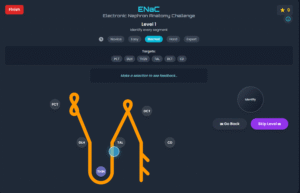
The nephron is presented as an interactive map. Users identify:
- Segment locations and names (proximal convoluted tubule, descending loop, thin and thick ascending loop, distal convoluted tubule, collecting duct)
- Transporters and channels
- Sites of action for diuretics, RAAS modulators, and other medications
The gameplay is timed and scored, with an arcade-style leaderboard showing top performances. Learners can:
- Practice solo to improve speed and accuracy
- Challenge a colleague in a friendly “attending vs. fellow” or “senior vs. junior” match
- Repeat games to climb the leaderboard and reinforce learning over time
Try It Out The ENaC game is freely available at: https://enac-game.netlify.app/
What’s Next
Future updates may include disease-specific modules (e.g., Bartter syndrome, nephrotic syndrome) and more advanced pharmacology scenarios. Feedback from learners and educators will drive these developments.
Written by: Amrit Kirpalani, M.D., MEHP, FRCPC
Reviewed by: Arrsh Bajaj, M.D. and Matthew Sparks, M.D