Doc, this itching is making me crazy
Nearly every time I walk through the dialysis unit at the VA, at least one patient calls me over to tell me that their itchy skin is driving them crazy. Pruritus is a torment to many dialysis patients,…

Nearly every time I walk through the dialysis unit at the VA, at least one patient calls me over to tell me that their itchy skin is driving them crazy. Pruritus is a torment to many dialysis patients,…
As previously discussed on RFN, the single pool Kt/V (spKt/V) was developed by Gotch and Sargent in a reanalysis of the NCDS data in an attempt to distinguish the dose of hemodialysis associated with improved outcomes. The spKt/V…
As previously discussed on RFN, the urea Kt/V is a measure of dialysis dose that is related to patient outcome. There are several different Kt/Vs encountered in the dialysis literature. spKt/V = single pool eKt/V = equilibratedstdKt/V =…
A talk recently about the HIM study at MGH (Hypogonadism In Men, Clin trial NCT00114114) prompted me to wonder about testosterone from the renal perspective. Testosterone is important for several aspects of male health, including fertility, bone density,…
As part of the regular hemodialysis prescription, we as providers have to prescribe the type of membrane we want used for the procedure. This decision is mostly based on what membranes our dialysis unit chooses to buy –…
Sometimes overlooked, QT interval abnormalities, namely prolongation and dispersion, are important predictors of sudden death to watch out for in the dialysis unit. Of these two, prolongation of the QT interval is the better studied. The QT interval is…
I’ve recently had a few calls from our outpatient dialysis unit about patient’s with rises in their blood pressure during and after dialysis. Intradialytic hypotension is a very common phenomenon and it’s been interesting to learn that intradialytic…
The complete removal of a substance expressed as volume per unit time is known as clearance. The hemodialysis machine is built to be a urea clearance machine and typical urea clearance rates range from 200-260 ml/min, far more…
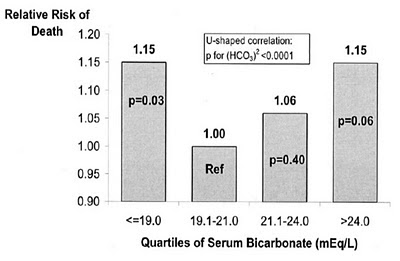
In our dialysis unit, the standard HCO3 bath is 35 mmol/L. While it is adjustable, it is rarely changed but recently we had a patient with a pre-dialysis HCO3 of 12 which got me thinking about what constitutes…
One of the commonest calls that one gets as a renal fellow in the dialysis unit concerns poor flows from catheters. This is often related to catheter-related thrombus formation and there are a number of different strategies employed…