
Anti-Nephrin Antibodies in Minimal Change Disease
Approach to the Patient with Peritoneal Dialysis Catheter Dysfunction- Part 1
Want to write a case report? RFN has you covered with a list of journals to choose from
Have a Nephrology Question? There Might Be A #Tweetorial For That!
Conferences, Courses, & Grants
FOAMed
Interventional Nephrology Series
Focus on Point-of-Care Ultrasound in Nephrology (POCUN) Series
Kidney Biopsy of the Month Series
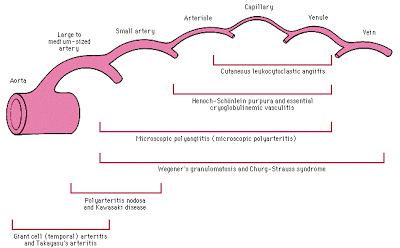
Churg-Strauss Syndrome
There is a patient now on the renal consult service with Churg-Strauss Syndrome. This disease falls under the category of “small vessel vasculitis” and most commonly is thought of as a pulmonary disease, as the characteristic triad consists…
Acute Phosphate Nephropathy
It has long been known that acute phosphate toxicity–as might be seen in rhabdomyolysis or tumor lysis syndrome–can lead to acute kidney injury as a result of calcium-phosphate deposition in the renal parenchyma and tubules. Interestingly, this problem…

History of Dialysis
When discussing the history of dialysis, any renal fellow worth his weight in urine will know that the inventor of the first practical dialysis machine (the “rotating drum” machine shown at left, which consisted of 30-40 meters of…

Lithium as a dialyzable toxin
Lithium is one of the classic dialyzable toxins, as it is very small (atomic # of 3) and elevated Li levels (>2.5 meq/L) may result in tremor, ataxia, vomiting, seizures, or even coma. However it is somewhat unique…

High Flux versus Hemofiltration
There has been a lot of attention these days regarding increasing “middle molecule clearance”, a topic already covered previously here. Certainly it is well-established that buildup of beta-2-microglobulin can lead to a dialysis-derived form of amyloidosis, and it…

Hepatorenal Syndrome: Treatment Options
Hepatorenal syndrome (HRS) is thought to be caused by splanchnic vasodilatation with relative renal vasoconstriction. The reversible nature of HRS is highlighted by the observation that patients with HRS who undergo liver transplant usually see a complete reversal…

Hepatorenal Syndrome: Definitions
Hepatorenal syndrome is a very common consult topic for the 1st year renal fellow. All MDs trained in internal medicine realize that cirrhotic patients are amongst the sickest in the hospital, and one of the reasons for this…
AKI criteria
The study of acute kidney injury has been hampered by a lack of a standard definition. Some of this is semantics–for instance, the decision to change “acute renal failure” to “acute kidney injury” does nothing to help in…

Renal manifestations of rheumatoid arthritis
Renal disease is not uncommon in patients with rheumatoid arthritis, and the differential diagnosis is quite interesting. Here is a list of the major causes, some of which are caused by the RA itself and others of which…
The Latest on FGF23
There has been a lot of buzz surrounding the recent NEJM article by Gutiérrez (a recently graduated fellow from my program!) et al regarding the potential role of measuring FGF23 levels as an important biomarker in patients with…