
Anti-Nephrin Antibodies in Minimal Change Disease
Approach to the Patient with Peritoneal Dialysis Catheter Dysfunction- Part 1
Want to write a case report? RFN has you covered with a list of journals to choose from
Have a Nephrology Question? There Might Be A #Tweetorial For That!
Conferences, Courses, & Grants
FOAMed
Interventional Nephrology Series
Focus on Point-of-Care Ultrasound in Nephrology (POCUN) Series
Kidney Biopsy of the Month Series

Bardoxolone for diabetic CKD preliminary results presented at ASN
Preliminary results from a phase IIb clinical trial funded by Reata Pharmaceuticals and Abbott were presented at ASN Renal Week 2010 in Denver, CO last month. This study looked at the novel drug bardoxolone (RTA 420) in diabetic…
Drug-induced hyponatremia
When reviewing a consult patient with hyponatremia, the first thing I look at is the medication list to see if the culprit is to be found there. Along with the usual suspects – diuretics, NSAIDs, SSRIs and anti-convulsants,…

Lupus – persistent low complements
Consider a patient with long-standing SLE who has biopsy proven WHO class IV lupus nephritis, previously treated with cyclophosphamide and steroids, which induced remission. Due to recurrence of proteinuria and desire to remain steroid-free, MMF was commenced with…

High Maintenance
Many nephrologists will have faced “interesting specialty, shame about the evidence-base” jokes in the past. However, following a profusion of randomised controlled trials in lupus nephritis, we are now entering an era where we can integrate data to…

Pseudohyperkalaemia with extreme leucocytosis
We were following a CKD patient with CLL in hospital with the haematology team. One morning, out of the blue, his potassium came back at 6.5mmol/L. It had been stable in the high four range for the duration…

Should you stop ACE inhibitors prior to major surgery for renoprotection?
I must admit that I have always routinely advised holding ACE/ARB prior to major surgery, given the possibility of hemodynamic instability and assumed risk of AKI due to impaired renal autoregulation when perfusion pressure is low. I’m prepared…

Clearance and Kt/V
The complete removal of a substance expressed as volume per unit time is known as clearance. The hemodialysis machine is built to be a urea clearance machine and typical urea clearance rates range from 200-260 ml/min, far more…
What about the Bicarb?
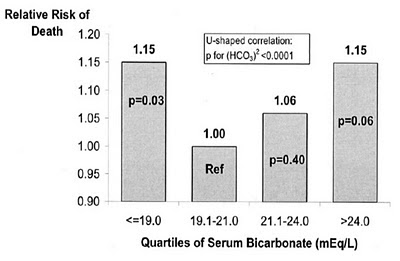
In our dialysis unit, the standard HCO3 bath is 35 mmol/L. While it is adjustable, it is rarely changed but recently we had a patient with a pre-dialysis HCO3 of 12 which got me thinking about what constitutes…

Physiological changes of pregnancy
Here are some interesting points I picked up at an ASN review to reinforce Gearoids post discussing changes in reference values during pregnancy and Michael’s board review post which covers a lot of the physiology also. Kidneys increase…
How to manage lithium toxicity
I recently saw a patient in the emergency department with chronic lithium toxicity and took the opportunity to do some review. Three broad patterns of lithium toxicity are recognized: Acute toxicity – Seen in patients not previously taking…