
Anti-Nephrin Antibodies in Minimal Change Disease
Approach to the Patient with Peritoneal Dialysis Catheter Dysfunction- Part 1
Want to write a case report? RFN has you covered with a list of journals to choose from
Have a Nephrology Question? There Might Be A #Tweetorial For That!
Conferences, Courses, & Grants
FOAMed
Interventional Nephrology Series
Focus on Point-of-Care Ultrasound in Nephrology (POCUN) Series
Kidney Biopsy of the Month Series

New Year’s Eve Poll Results
Happy New Year’s Eve! I found the results of last week’s poll to be surprising…well, I guess I shouldn’t be too shocked to see that Nephrology Fellows won the “hardest working fellow in show business” award, being that…
Complications of EPO Use
Well, I had hoped to be more of an active blogger during my holiday vacation this year, but my internet access has been much spottier than desired way out in the boondocks of Western France (not that I…
A second look at dilantin
The first time phenytoin was addressed as a blog on this site was on the one year anniversary of the inauguration of the RFN. I’d just like to bring it up again, because a question pertaining to phenytoin…

Mount Rushmore of Nephrology Announced
The readers have spoken and it is time to announce the results of the hypothetical “Mount Rushmore of Nephrology”: the four Nephrology Pioneers whose contributions have mattered most, and deserve to have their imagery preserved forever on a…

Angiojet as a Cause of AKI??
The Angiojet Rheolytic Thrombectomy System is a medical device currently used to re-establish blood flow in a variety of settings. Briefly, a catheter is introduced into an area of thrombosis and a saline stream is directed towards the thrombus of…

Differential Diagnosis of Red Urine
Red urine: it’s not always hematuria. The first step in evaluating the patient who complains of grossly red urine is to perform a standard urinalysis, focusing on (a) whether or not the dipstick turns heme-positive, and (b) whether…

Cardiovascular Complications of Kidney Disease
Question: Who is the most important medical subspecialist for a patient with CKD to have regular contact with? Is it the nephrologist? A case could be made, relying purely on mortality statistics, that it’s actually the cardiologist. CKD/ESRD…
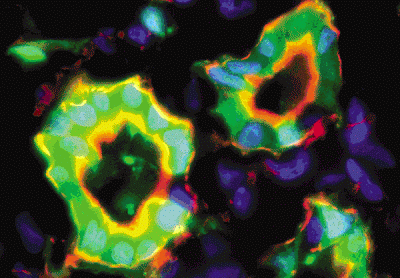
Ischemia-Reperfusion Models
The study of AKI/ATN has relied heavily on one particular animal model: the warm ischemia-reflow model (often referred to as “ischemia-reperfusion injury”), in which one of the renal arteries is transiently ligated off for a set period of…
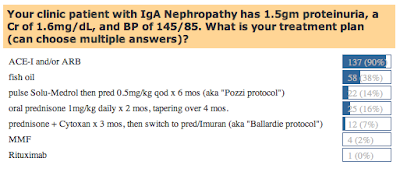
IgA Nephropathy Treatment Poll Results
The results of last week’s poll on IgA Nephropathy are in: 90% of individuals correctly identified that the only treatment shown in randomized controlled trials to consistently benefit patients with IgA Nephropathy is ACE-inhibitors and/or ARBs. The response…

Transplant Glomerulopathy
As acute rejection rates continue to fall, causes of late allograft loss, such as transplant glomerulopathy (TG), become increasingly important. TG should spring to mind when you encounter a renal transplant recipient who develops heavy proteinuria and progressive…