
Anti-Nephrin Antibodies in Minimal Change Disease
Approach to the Patient with Peritoneal Dialysis Catheter Dysfunction- Part 1
Want to write a case report? RFN has you covered with a list of journals to choose from
Have a Nephrology Question? There Might Be A #Tweetorial For That!
Conferences, Courses, & Grants
FOAMed
Interventional Nephrology Series
Focus on Point-of-Care Ultrasound in Nephrology (POCUN) Series
Kidney Biopsy of the Month Series

Congenital Nephrotic Syndrome
Congenital nephrotic syndrome only makes up between 2-8% of all forms of nephrotic syndrome, but is a hot topic in that there are numerous genes continuously being identified which are helping to advance our understanding of podocyte biology….

Toluene & The Kidney
Toluene–a hydrocarbon which is present in gasoline, paint thinners, and many industrial solvents–can have a variety of effects on acid-base metabolism by the kidney: it can cause both a non-anion gap OR an anion gap metabolic acidosis, depending…

“Full House” Immunostaining
Renal pathologists may throw out the term “full house” immunostaining…what does this mean? This means quite simply that all five major immunofluorescent stains on a renal biopsy (IgM, IgG, IgA, C3, and C1q) are all positive. The analogy…

Hypertension/Brachydactyly Syndrome
One of the as-yet unresolved major controversies in nephrology is whether or not the entity “hypertensive nephropathy” really exists. Certainly there are a large percentage of the dialysis population who do not have diabetic nephropathy, glomerulonephritis, nephrotic syndrome,…

MYH9
Any nephrologist practicing in the U.S. does not need to be told that there is an increased incidence of end-stage renal disease in blacks. Furthermore, certain diseases–such as collapsing focal segmental glomerulosclerosis (FSGS), occur almost exclusively in black…

The Declaration of Istanbul
In this month’s C-JASN, “The Declaration of Istanbul” is presented. Recently a group of world leaders of the transplant community held a meeting in Istanbul, Turkey during which the general topic of discussion was the ethics of…

gemcitabine-induced thrombotic microangiopathy
Another oncologic medication with a specific renal side effect is gemcitabine (Gemzar), a nucleoside analogue used with frequency to treat cancer of the lung, pancreas, breast and colon to name a few. Gemcitabine can cause a thrombotic…
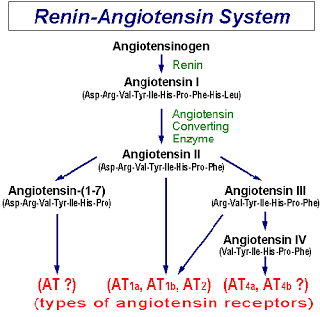
ACE DD Polymorphism
The human angiotensin coverting enzyme (ACE) gene is located on chromosome 17q23 and is comprised of 26 exons and 25 introns. Importantly, there is an insertion/deletion polymorphism in which a 278-bp fragment is either present or absent within…

What are Randall’s Plaques?
The latest theories on nephrolithiasis involve an anatomical lesion termed “Randall’s Plaques”, which are calcified, whitish plaques in the renal papillae which may be visualized during endoscopy (see arrows in Figure a, taken from a JCI paper by…

Oxalate and Risk for Nephrolithiasis
Hyperoxaluria is one of the well-established risk factors for stone formation; this certainly makes sense as the most common type of kidney stone is of the calcium oxalate variety. Interestingly, having high levels of serum oxalate does not…