
Anti-Nephrin Antibodies in Minimal Change Disease
Approach to the Patient with Peritoneal Dialysis Catheter Dysfunction- Part 1
Want to write a case report? RFN has you covered with a list of journals to choose from
Have a Nephrology Question? There Might Be A #Tweetorial For That!
Conferences, Courses, & Grants
FOAMed
Interventional Nephrology Series
Focus on Point-of-Care Ultrasound in Nephrology (POCUN) Series
Kidney Biopsy of the Month Series

Location of Culprit Lesion in Acute MI’s in CKD Patients
The presence of chronic kidney disease (CKD) portends a much higher mortality in patients who suffer an acute myocardial infarction. There are several potential reasons as to why this might be the case–for instance, the treatment of resultant…
Doing My Part for Kidney Awareness
So it was my Dad’s 65th birthday this past weekend, and the kids & grandkids all flew in to Indianapolis to help him celebrate. As my father is also a nephrologist, I wanted there to be a kidney…

The CKD-Epi Equation: An Improved MDRD?
Currently, the most widely-utilized method for routine estimation of GFR (eGFR) is the 4-variable MDRD Equation, in which serum creatinine, age, gender and race are the variables entered into a mathematical formula. eGFR as determined by the MDRD…

The Power of Pee
Often, my ideas for blog postings come from reputable journals such as JASN, CJASN, AJKD, Kidney International, NEJM, etc… But today’s topic derives from my regular reading a website I simply can’t recommend highly enough…Geekologie. From the July…

Rapamycin for ADPKD?
Another potentially useful drug to prevent cyst growth in autosomal dominant polycystic kidney disease comes from the interesting observation that kidney transplant patients with native ADPKD kidneys who were given an immunosuppressant regimen containing the drug rapamycin (sirolimus)…
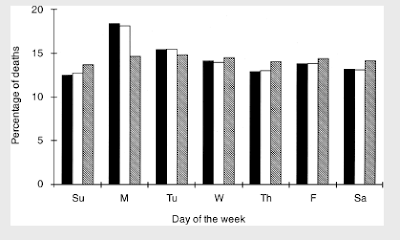
Sudden cardiac death rates in ESRD patients
The case against Sunday As A Day Of Rest For the Dialysis Unit: this older study (Bleyer et al, Kidney International 1999) looked at sudden death amongst ESRD patients according to days of the week using data from…

PRES
The MRI above depicts a classic example of posterior reversible encephalopathy syndrome (PRES), sometimes also called reversible posterior leukoencephalopathy, an increasingly-recognized consequence of malignant hypertension. The whitish areas (“hyper-intense signal”) in the bilateral occipital and parietal lobes represent…

A recession-proof profession?
How many nephrologists does the U.S. need? I recently heard a thought-provoking calculation from MGH’s Dr. David Steele which helps illustrate a likely shortage in the number of American nephrologists. The calculation is admittedly a rough estimate, but…

Why Do U.S. ESRD Patients Do So Poorly?
The Dialysis Outcomes and Practice Patterns Study (DOPPS) is an important longitudinal study of ESRD patients in multiple countries, and is the source of much respected epidemiologic data on dialysis patients worldwide. Interestingly, the DOPPS estimated the crude…

Some Cool, Geeky Science-Type Kidney Web Resources
Two very interesting web sites for those involved in the study of mouse as a model organism for the study of kidney disease and kidney development: The first is the Genitourinary Development Molecular Anatomy Project (GUDMAP) site, which…