
Anti-Nephrin Antibodies in Minimal Change Disease
Approach to the Patient with Peritoneal Dialysis Catheter Dysfunction- Part 1
Want to write a case report? RFN has you covered with a list of journals to choose from
Have a Nephrology Question? There Might Be A #Tweetorial For That!
Conferences, Courses, & Grants
FOAMed
Interventional Nephrology Series
Focus on Point-of-Care Ultrasound in Nephrology (POCUN) Series
Kidney Biopsy of the Month Series

Bad Odor
Cystinosis is an autosomal recessive disease caused by a mutation in CTNS, which encodes the lysosomal transporter of cystine. This leads to intracellular cystine accumulation which leads to renal, neurological and cardiac damage. The treatment for this condition…
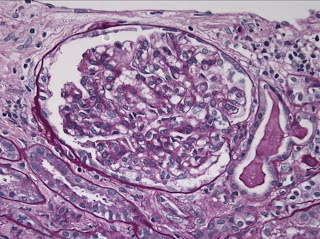
Image of the Month – Pathology
A woman in her early 30s presented to the renal clinic with sudden onset edema. Her urinalysis revealed 4+ protein and 3+ blood. Dysmorphic red cells were noted on microscopy. Apart from her edema, she had no other…

Origins of Renal Physiology
Every year we like to publicize the MDIBL origins of renal physiology course. This is a great opportunity for renal fellows and the fact that it is free apart from transportation costs is a huge bonus. This is…

Skin Lesions in Dialysis – Part 5
Nail changes in renal failure: Half and half nails (Lindsay’s nails) can be found in patients with any degree of azotemia. The prevalence is about 21% in dialysis patients. the proximal half of the nail is white and…

Skin Lesions in Dialysis – Part 4
Acquired Perforating Dermatoses: Perforating dermatoses are a group of conditions characterized by transepidermal elimination of dermal material (collagen, elastic tissue or necrotic connective tissue) (CMAJ). APD is one of the 4 major perforating disorders: Reactive perforating collagenosis (inherited…
Skin Lesions in Dialysis – Part 3
Nephrogenic Systemic Fibrosis (NSF) No post or summary on skin disorders in renal failure can omit NSF. This has been mentioned in multiple previous posts on RFN – although never summarized: The first cases of this disorder were…

Electrolyte Disorders involving Tubular Channels
Though adult nephrologists infrequently encounter these disorders in clinic, the Board Exam loves them. Below a short table describing some of these gain- and loss-of-function channel disorders that are worth remembering. The diuretic-targeted channels are shown under parenthesis…
Bardoxolone – The Final Chapter – Part 2
One of the issues surrounding the study of bardoxolone in animal models was that, because of the way that it is metabolized in rats and mice, it is highly toxic when given for long periods. This specific toxicity…

New JAMA Reader
JAMA has a new platform called the JAMA Network Reader that you can use to get access to content from any of the JAMA journals (includes what were formerly called Archives of …). All the content (which includes…
Skin Lesions in Dialysis – Part 2
Phototoxic skin disorders in renal failure: Patients with renal failure or ESRD secondary SLE can have a photosensitive skin rash. For example: Discoid Lupus Erythematosus (DLE); these lesions are thick and scaly, plug the hair follicles, appear usually…