
Anti-Nephrin Antibodies in Minimal Change Disease
Approach to the Patient with Peritoneal Dialysis Catheter Dysfunction- Part 1
Want to write a case report? RFN has you covered with a list of journals to choose from
Have a Nephrology Question? There Might Be A #Tweetorial For That!
Conferences, Courses, & Grants
FOAMed
Interventional Nephrology Series
Focus on Point-of-Care Ultrasound in Nephrology (POCUN) Series
Kidney Biopsy of the Month Series

Lesch-Nyhan Syndrome
I remember learning about Lesch-Nyhan and thinking it was fascinating early on during a college course on neurology & behavior: affected children with this X-linked disorder develop the bizarre but highly characteristic behavior of self-mutilation, intentional biting of…

Immunosuppressant Drugs in Pregnancy
Is something missing in your life? Is it the opportunity to take multiple-choice exams? If so, check out this 10-question ASN-sponsored practice test designed to prepare Nephrology Fellows to be ready for the upcoming Nephrology Boards in November….

Stone Disease in ADPKD
Patients with ADPKD are predisposed to nephrolithiasis. The postulated reasons for this increased prevalence of stone disease have ranged from metabolic abnormalities (previous reports have shown an increased tendency for hyperoxaluria, hypercalciuria, hypocitraturia, hyperuricosuria, and distal RTA) to…

Congenital analbuminemia
Plasma oncotic pressure is important to prevent edema, right? And you would think that albumin, which plays a critical role in the binding of multiple plasma proteins and ionized calcium, is essential to life, right? The rare, autosomal…

EMT = epithelial-to-mesenchymal transition
The three letter acronym EMT: what should it mean to nephrologists? Not just “emergency medical technician”…but also “epithelial-to-mesenchymal transition.” As we all know the nephron is comprised of a long tube of highly-differentiated epithelial cells. These cells…
The Important Stuff
It’s important to teach your kids the important stuff in life…like, for instance, the fact that the kidneys are located in a retroperitoneal location, as demonstrated by my daughter.

Differential Diagnosis of Nodular Glomerulosclerosis
I recently had to look up the differential diagnosis of nodular glomerulosclerosis: we had recently sent a clinic patient to undergo a renal biopsy based on a history of nephrotic-range proteinuria (urine protein to creatinine ratio of about…
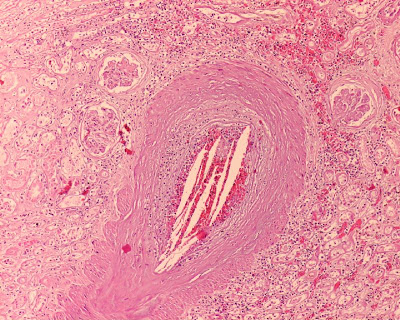
atheroembolic renal disease
I heard a lecture not too long ago on atheroembolic renal disease which claimed that atheroembolic renal disease is to nephrology as sarcoidosis is to internal medicine. That is to say, it can present in a myriad of…

Reticular Inclusions in HIVAN
The histology of HIVAN (HIV-Associated Nephropathy), at the light microscopy level, is indistinguishable from that of collapsing FSGS: the glomerular capillary loops are collapsed. Furthermore, both entities demonstrate foot process effacement (as in all forms of nephrotic syndrome)…

MMF Basics
Mycophenolic acid is a commonly encountered medication in nephrology. In addition to its use in the vast majority of kidney transplant recipients as part of the immunosuppressive regimen, it is also gaining popularity in the treatment of immune-mediated…